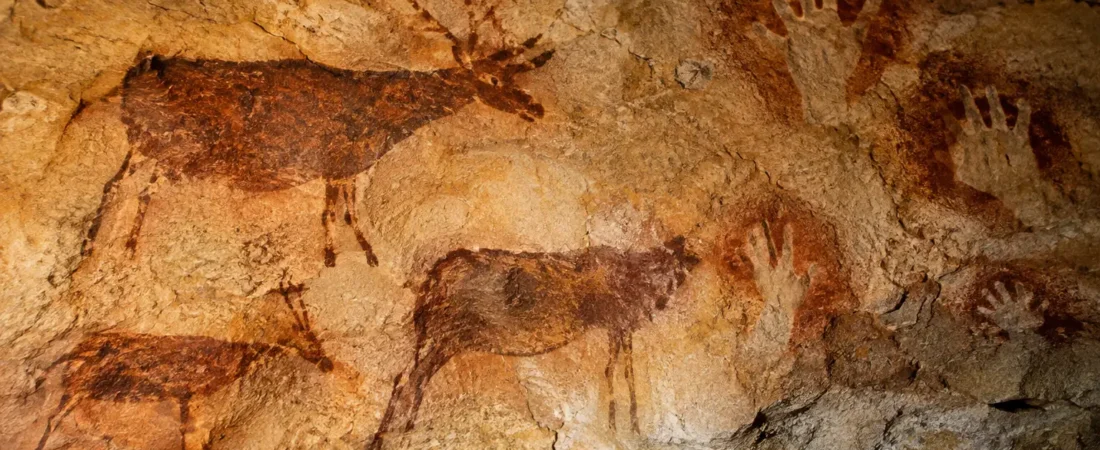
A torch flame shivers against limestone. For a few seconds, a painted horse seems to move across the wall: its belly swells with the curve of the rock, its mane lifted as if caught in motion. Then darkness returns. This is the world of prehistoric cave art, where images made tens of thousands of years ago still confront us with startling immediacy.
These paintings, engravings, hand stencils, and clay models are not simply the first chapter of art history. They are evidence of people thinking visually, gathering knowledge, marking places, and perhaps reaching toward ideas that could not be held in ordinary speech. Their meanings are not fully recoverable, and certainty must be handled with care. Yet the survival of these images gives us an unusually intimate encounter with Ice Age minds.
What Prehistoric Cave Art Shows Us
Most famous cave art belongs to the Upper Paleolithic, a broad period beginning roughly 45,000 years ago in Europe and extending to the end of the last Ice Age around 11,700 years ago. But rock art is a global human practice, created at different times and in different forms from Indonesia and Australia to southern Africa, Europe, and the Americas.
The classic European galleries are crowded with animals: horses, bison, aurochs, ibex, deer, mammoths, and lions. At Lascaux in southwestern France, painted bulls and galloping horses occupy cavern walls with extraordinary confidence. At Chauvet Cave, also in France, artists depicted dangerous predators, including cave lions, rhinoceroses, and bears, with shading and overlapping lines that create a powerful sense of depth.
Humans appear less often, but their presence is unmistakable. A hand stencil begins with a hand pressed against stone while pigment is blown around it, leaving a pale silhouette when the hand is removed. Some show missing or folded fingers, though scholars still debate whether this reflects gesture, injury, cold, or artistic convention. Other images show humanlike figures, sometimes combined with animal features. The famous bird-headed figure at Lascaux is among the most discussed, precisely because it refuses an easy explanation.
There are also dots, lines, ladders, grids, branching marks, and repeated signs. These may have carried shared meanings, but they cannot automatically be treated as writing. A recurring shape can indicate a convention without representing a word. The difference matters. Prehistoric artists may have used complex systems of communication, but the evidence does not allow us to read their walls as if they were a lost alphabet.
Entering a Painted Cave
The settings themselves change how we should view the art. Some works were created near cave entrances, where daylight could reach. Others lie far inside chambers reached only by squeezing through narrow passages or walking deep underground. At places such as Lascaux and Chauvet, the journey was part of the encounter.
Imagine carrying a stone lamp fueled by animal fat. Its small pool of light would isolate one panel at a time. A drawn line might vanish and reappear as the viewer moved; the natural bulges and cracks of the wall could become a bison’s shoulder or a horse’s flank. Many images were made where flickering light would have animated their contours. That does not prove they were designed as performances, but it reminds us that a modern photograph captures only a fraction of their original effect.
The artists used materials close at hand but applied them with skill. Charcoal produced black. Iron-rich ochre created reds, yellows, and browns. Manganese oxides could make darker tones. Pigments were ground, mixed with liquid or binders, then applied with fingers, pads, brushes, or blown through hollow bones and reeds. Engraving with stone tools added another layer of technique. At some sites, artists scraped surfaces clean before painting, preparing the cave wall much as a later painter might prepare a canvas.
A Timeline Written in Stone
The dates below show why cave art is not a single European invention or a brief artistic fashion. It emerged across vast distances and endured through changing climates and cultures.
- More than 45,000 years ago: A painted warty pig at Leang Tedongnge in Sulawesi, Indonesia, was dated to at least 45,500 years old, placing figurative cave painting remarkably early in the human story.
- About 37,000 to 33,000 years ago: Chauvet Cave’s earliest paintings were made in France, including lions, rhinos, horses, and bears.
- About 21,000 to 14,000 years ago: Major painted sequences developed at Lascaux and Altamira, as Ice Age communities continued to refine techniques and visual traditions.
- In later prehistoric eras: Rock art continued worldwide, often shifting from deep caves to open shelters, cliffs, and boulders, with new subjects reflecting new ways of life.
Dating this art is difficult, and dates often come with ranges rather than a single final answer. Charcoal can sometimes be radiocarbon dated directly. Mineral crusts that formed over paintings can be examined through uranium-series dating, providing a minimum age. Style can also help place an image within a broader sequence, but stylistic dating is less secure when used alone. Each method has limits, which is why responsible archaeology compares several lines of evidence.
Why Did Ice Age People Make It?
The tempting answer is that cave paintings were magic for hunting: paint the animal, then gain power over it. Hunting may have mattered in some cases, but the idea is too narrow to explain everything. At Chauvet, predators appear far more often than one would expect from a straightforward hunter’s wish list. Many animals painted in caves were not the ones most commonly eaten.
Other interpretations see caves as places for ritual, storytelling, teaching, memory, or encounters with a spirit-filled landscape. Repeated animal forms may have expressed seasonal knowledge, clan identity, or social bonds. Handprints could be signatures, declarations of belonging, or acts of participation. Some scholars have explored whether trance experiences influenced certain abstract motifs, while others stress that abstract signs may have had practical, culturally learned meanings.
The honest answer is that it depends on the site, the image, and the community that made it. A hand stencil, a herd of horses, and a hidden panel of engraved marks need not have served the same purpose. The strongest conclusion is also the most human one: these images mattered enough for people to return, prepare materials, carry light into darkness, and work together in places where survival already demanded enormous effort.
The Fragility of a 40,000-Year-Old Gallery
Cave art has survived because caves can be stable environments, but that stability is delicate. Changes in temperature, humidity, carbon dioxide, microbes, and water movement can damage pigments or encourage destructive growth on walls. Human breath alone can alter a confined chamber when visitors arrive in large numbers.
Lascaux is a defining lesson. After its discovery in 1940, the cave drew crowds eager to see its painted bulls. Within years, visitor traffic contributed to serious conservation problems. The original cave was closed to the public in 1963. Today, carefully made replicas allow visitors to experience the scale and drama of the art while protecting the authentic paintings.
Replicas are sometimes dismissed as substitutes, but they serve an essential purpose. They make access possible without asking a fragile site to absorb endless foot traffic. Digital recording, high-resolution photography, 3D scanning, and environmental monitoring offer further ways to study art without touching it. Preservation can feel like a barrier between us and the past. In reality, it is a promise that the past will remain available to those who come after us.
Prehistoric Cave Art and the Human Need to Leave a Mark
What endures most strongly in these caves is not a solved mystery but a recognition. The artists who pressed hands to stone knew that an image could outlast the moment of its making. They observed animals closely, understood the expressive force of a line, and chose spaces where darkness made an image feel newly alive.
We may never know the names of the people who painted the horses at Lascaux or the lions at Chauvet. But their work asks us to slow down before the urge to explain it away. Stand, at least in imagination, beside the wavering light. Look at the hand on the wall. Across an immense distance of time, someone made that mark and left room for us to answer it with attention.