A weathered tree stood at the edge of an abandoned settlement when Governor John White finally returned to Roanoke Island in August 1590. On its trunk was carved a single word: “CROATOAN.” Nearby, the letters “CRO” appeared on a post. There were no bodies, no wreckage, no desperate message, and no colony of 115 English men, women, and children. The surviving Roanoke colony disappearance evidence begins with those carvings, but it does not end there.
For more than four centuries, the Lost Colony has invited tales of massacre, storm, disease, and mystery. Yet the most compelling historical picture is less supernatural and more human: a vulnerable community may have scattered, adapted, and been absorbed into the Native American world around it. The evidence is incomplete, sometimes frustratingly indirect, but it points toward possibilities that can be weighed rather than merely imagined.
The Last Days of the Roanoke Colony
Roanoke was England’s second serious attempt to establish a permanent foothold in North America. The 1587 expedition was led by John White, an artist and mapmaker appointed governor of the colony. Its intended destination was the Chesapeake Bay, but its ships left the settlers on Roanoke Island, off the coast of present-day North Carolina.
The colony included families, not only soldiers and adventurers. White’s daughter, Eleanor Dare, gave birth to Virginia Dare there in August 1587, the first English child known to have been born in the Americas. The settlers needed supplies, allies, and a more secure location. White sailed back to England that same year to gather provisions.
He expected to return quickly. Instead, England’s war with Spain and the threat of the Spanish Armada delayed him for nearly three years. When White reached Roanoke on August 18, 1590, the settlement had been dismantled. Houses had been carefully taken down rather than destroyed in a violent attack. The fortification had been strengthened with a palisade.
Before leaving, White had arranged a simple distress signal: if colonists were forced away under attack, they were to carve a Maltese cross into a tree. No such cross was found. To White, the absence mattered. The carved word CROATOAN suggested that the colonists had relocated voluntarily to Croatoan Island, now called Hatteras Island, home to the Croatoan people.
A storm prevented White’s crew from sailing there to investigate. He never saw the settlers again.
Roanoke Colony Disappearance Evidence in the Carvings
The inscriptions are the closest thing the Lost Colony left behind in its own hand. They deserve more attention than many later legends.
“CROATOAN” was not a cryptic word invented by the vanished colonists. It was the name of an island and the Native community living there. The English already knew the Croatoans, and relations with them had generally been better than those with other groups near Roanoke. Manteo, a Croatoan man who had traveled to England, served as an interpreter and ally during earlier English expeditions.
The carving therefore reads less like a final riddle than a destination. It may have meant the whole colony had moved to Croatoan Island, or that at least a group had gone there. The difference is crucial. A settlement of 115 people could have divided in response to hunger, conflict, or the practical difficulty of finding a place to live.
The physical state of the abandoned settlement supports departure over sudden annihilation. White reported that the houses were gone and the area looked overgrown, which was expected after three years. There was no clear evidence of a battle. Still, an orderly departure does not prove a peaceful future. The colonists may have left Roanoke by choice and later faced hardship elsewhere.
A Planned Move Inland
White had heard before his departure that some colonists wanted to move about 50 miles inland. That plan makes sense. Roanoke Island was exposed, supplies were scarce, and the settlers had been deposited far from their intended Chesapeake destination. Inland communities could offer better farmland, fresh water, and trade routes.
This possibility gained renewed attention in 2012, when researchers examining a map drawn by John White noticed a small red-and-blue symbol concealed beneath a paper patch near the Albemarle Sound. The mark may indicate a fort or planned settlement site. The map itself does not prove where the colonists went, but it shows that English leaders considered the region strategically significant.
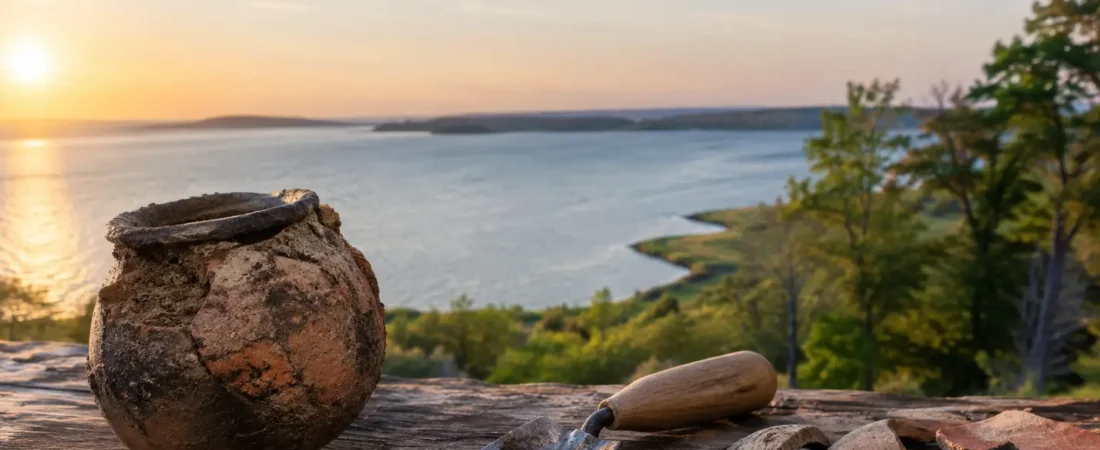
Archaeologists working at a location sometimes called Site X, near the western end of Albemarle Sound, have recovered a small number of objects associated with late 16th-century English activity. These include fragments of pottery, a gunflint, and metal items. Such finds are intriguing, especially because they appear in an area connected to the map’s hidden symbol.
But this is where careful history matters. English objects could have reached Native communities through trade, travel, or later colonial activity. A handful of artifacts cannot establish that the entire Roanoke colony lived there. The inland theory is plausible, not proven.
Hatteras Island and the Croatoan Connection
The Croatoan clue has also produced archaeological leads. Excavations on Hatteras Island have uncovered European materials dating to the late 1500s and early 1600s, including copper objects, a signet ring, and ceramics. Some discoveries may reflect contact, trade, or the presence of English people living among Native communities.
One especially evocative find is a small gold signet ring bearing a heraldic design. Its precise path to Hatteras cannot be known. It may have belonged to an English colonist, passed through exchange networks, or arrived by another route. Archaeology often works this way: an object can illuminate a possibility without delivering a verdict.
Later accounts add another layer. In the early 1700s, explorer John Lawson wrote that the Hatteras people had stories of English ancestors and that some members of the community had gray eyes. The account is fascinating but must be handled cautiously. Lawson was writing more than a century after the colony vanished, and physical appearance alone cannot establish ancestry. Oral traditions can preserve real memories across generations, but they also change as communities adapt and retell their past.
Even so, the Hatteras evidence fits the message on the tree better than theories requiring the colonists to vanish without a trace. Assimilation was not unusual on colonial frontiers. People joined other communities through alliance, marriage, adoption, coercion, or necessity. For English settlers who had lost their supply line, living with Native allies may have been the most practical path to survival.
Reports of Violence and Their Limits
Not every historical source points toward peaceful relocation. Early Jamestown-era accounts recorded claims that some English settlers from Roanoke had been killed by powerful Native groups in the region. Captain John Smith and later writer William Strachey reported information associated with Powhatan, leader of a confederacy in coastal Virginia.
These reports are difficult to interpret. They were recorded years after Roanoke’s disappearance, filtered through translators and colonial rivalries, and may refer to only part of the lost population. A violent attack could have struck colonists who moved north toward the Chesapeake, while other groups traveled south or inland. The evidence does not require one single fate for every settler.
That may be the hardest adjustment to make. The phrase “Lost Colony” encourages a single dramatic ending. Real communities seldom disappear so neatly. Roanoke’s people could have split into smaller parties, with some dying from disease or violence, some moving inland, and some becoming part of Croatoan or other Algonquian-speaking communities.
What the Evidence Can and Cannot Say
The strongest Roanoke colony disappearance evidence is the abandoned but apparently dismantled settlement, the word CROATOAN, the missing distress cross, and the documented possibility of moving inland. Together, these facts make voluntary relocation highly likely.
The archaeological finds from Hatteras and the Albemarle region make several destinations credible. They do not yet identify a large, intact English settlement or name individual colonists. Likewise, later Native oral traditions and English reports of violence are valuable historical clues, but neither can settle the question alone.
The mystery persists partly because water, erosion, development, and time have altered the Carolina coast. Roanoke Island itself is not the landscape John White knew. Archaeologists are searching not only for a vanished village but also for evidence that may lie beneath shifting shorelines, forests, fields, and modern communities.
The next meaningful discovery may not be a dramatic cache marked with a colonist’s name. It may be a broken ceramic vessel in a Native household site, a new reading of an old map, or a carefully excavated layer that reveals English and Indigenous lives overlapping in one place. Roanoke reminds us that history is often recovered in fragments, and that respecting those fragments is the surest way to hear what the past still has to say.