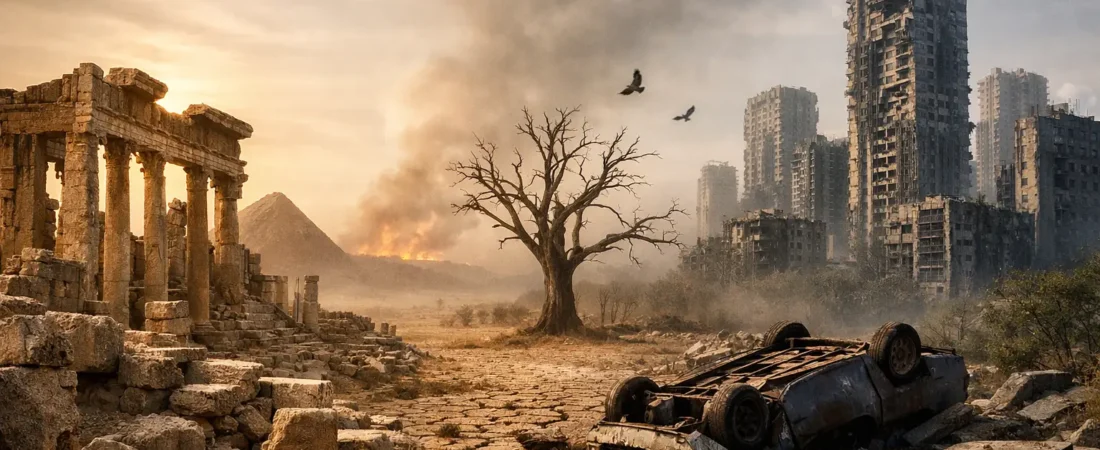
A city does not usually die in a single dramatic instant. Its markets grow quieter. A canal goes unrepaired. Officials demand taxes that villagers can no longer pay. Storehouses empty, roads become unsafe, and families leave one by one. When we ask why did civilizations collapse, the evidence rarely points to one fatal blow. More often, it reveals a chain of pressures that turned a once-resilient society brittle.
The ruins of Rome, the abandoned Maya cities, and the shattered palace centers of the Bronze Age can make collapse seem inevitable, even mysterious. Yet these were not failures of intelligence or character. They were human societies confronting drought, disease, invasion, political conflict, and changing economic realities – sometimes all at once. Their stories are less like a final curtain and more like a difficult transformation.
Collapse Was Usually a Process, Not an Ending
Archaeologists use the word “collapse” carefully. It often means a rapid loss of political authority, population, long-distance trade, urban life, or cultural complexity. It does not necessarily mean that every person vanished.
When the Western Roman Empire lost its last emperor in 476 CE, millions of people continued to live across former Roman lands. They still farmed, worshiped, traded, spoke local forms of Latin, and reused Roman roads, bathhouses, and buildings. What disappeared was the vast imperial system that had collected taxes, paid armies, maintained infrastructure, and connected Britain to North Africa and Syria.
This distinction matters. A collapsed state can leave behind surviving communities, new kingdoms, altered languages, and traditions that endure for centuries. For those living through it, however, the loss of institutions could be profound. A broken aqueduct or abandoned harbor was not merely a symbol. It could mean less clean water, less food, fewer jobs, and a narrower world.
Why Did Civilizations Collapse? Stress Met Weakness
No single explanation fits every civilization. Climate change did not destroy Rome by itself. Invaders did not simply erase the Maya. Disease alone did not end the Aztec Empire. The strongest historical explanation is usually a combination: external shocks hit societies already burdened by internal weaknesses.
A useful way to picture this is a ship in rough water. Drought, war, and epidemics are the waves. Debt, rigid leadership, inequality, overdependence on one crop, and damaged ecosystems are cracks in the hull. A well-maintained ship can survive a storm. A neglected one may founder.
Climate and environmental pressure
Climate has shaped history without dictating it. Long droughts are associated with political upheaval in several ancient societies, including parts of the Classic Maya world between the eighth and tenth centuries CE. In the limestone lowlands of southern Mesoamerica, large cities depended on seasonal rainfall and carefully managed reservoirs. When repeated droughts arrived, water systems and food production came under extraordinary strain.
But drought was not a universal death sentence. Some Maya communities adapted, shifted political centers, or continued long after famous southern cities declined. The northern city of Chichen Itza, for example, rose to prominence during a period when many southern centers were weakening. The Maya did not disappear. Their descendants remain across Mexico and Central America today.
Environmental damage could make a hard season disastrous. Deforestation, soil erosion, salinization from irrigation, and pressure on farmland reduced the margin for error. In ancient Mesopotamia, irrigated agriculture brought abundance but could also leave salts in the soil over generations. Prosperity often carried a hidden cost when populations grew faster than landscapes could recover.
Political systems that could not bend
Large states offer security, law, and shared infrastructure. They can also become expensive to maintain. Palaces, armies, elite households, border defenses, and monumental projects require labor and taxation. In good years, these demands may seem manageable. In bad years, they can deepen resentment and push local communities toward rebellion or withdrawal.
The Late Bronze Age collapse, around 1200 BCE, shows how quickly an interconnected political world can unravel. Palace kingdoms in Greece, Anatolia, the Levant, and Egypt depended on diplomatic exchange and long-distance shipments of copper, tin, grain, timber, luxury goods, and skilled workers. Then, within a few generations, many palace centers were destroyed or abandoned.
There were likely multiple causes: warfare, migration, internal unrest, earthquakes in some regions, and disruptions to trade. The exact role of the groups later called the Sea Peoples remains debated. What is clear is that tightly linked systems can spread crisis. If ships do not arrive, bronze cannot be made. If bronze weapons and tools are scarce, armies and farms suffer. A network that once created wealth can transmit failure with startling speed.
Inequality and loss of trust
Civilizations are held together not only by walls and armies, but by trust. People must believe that taxes provide protection, laws apply with some fairness, and leaders can respond to danger. When elites monopolize wealth while ordinary people bear the risks of hunger, debt, and violence, that trust weakens.
Ancient evidence does not always allow us to measure inequality precisely, but it often shows societies divided between powerful households and vulnerable laborers. In late Roman territories, many small farmers sought protection from wealthy landowners as imperial administration faltered. This did not cause Rome’s decline on its own, yet it changed where loyalty and resources flowed.
A government can survive a poor harvest. It struggles when people no longer see it as worth saving.
Disease, war, and the burden of bad timing
Some disasters arrive with terrifying speed. The Plague of Athens struck a crowded city already at war with Sparta in 430 BCE. Centuries later, the Antonine Plague and the Plague of Cyprian weakened the Roman Empire during periods of military pressure and political instability. Disease reduces population, labor, tax revenue, and military strength at the same moment that care and order are most needed.
War compounds these losses. Armies consume food, destroy crops, interrupt trade, and displace civilians. Yet invasion is often more successful when an empire is already divided or financially strained. The Germanic kingdoms that emerged in the western Roman world did not conquer a healthy, unified machine in a single stroke. They entered a landscape shaped by civil wars, fiscal difficulty, shifting alliances, and weakened central control.
The timing matters. A drought during peace may be endured. The same drought during epidemic, war, and political succession conflict can become a turning point.
The Civilizations That Adapted Are Part of the Story
History remembers ruins, but adaptation deserves equal attention. Ancient Egypt endured repeated periods of fragmentation and reunification. The Byzantine Empire survived crises that would have ended many states, partly by reorganizing its military, diplomacy, taxation, and defenses. After the decline of the western Roman state, new cultures blended Roman, Germanic, Christian, and local traditions.
Angkor offers another revealing case. The Khmer capital in present-day Cambodia built an immense water-management landscape of canals, reservoirs, and embankments. This system supported a major urban population, but it also required constant maintenance. Studies of sediment and damaged infrastructure suggest that severe climate swings, including drought and intense monsoons, placed it under pressure in the fourteenth and fifteenth centuries. Political and military changes added further strain.
Angkor was not simply swallowed by the jungle. Its political center shifted, religious life changed, and people reorganized their lives around new conditions. The stone temples remained, but the civilization moved.
What the Ruins Really Teach Us
The most haunting lesson from collapsed civilizations is not that complex societies are doomed. It is that complexity creates both strength and vulnerability. Trade networks bring resources, but dependence on distant suppliers can leave a society exposed. Centralized authority can coordinate great projects, but it can also fail spectacularly when leaders ignore local needs. Intensive agriculture feeds cities, but it may exhaust soils or magnify drought.
Archaeology helps us see these pressures in physical detail: abandoned granaries, altered pollen records, layers of ash, unfinished walls, shrinking house sizes, and repair marks on canals. Each fragment is a clue, not a complete verdict. Historians must resist the temptation to give every fallen civilization one neat cause.
The next time you stand before a ruined temple, a broken road, or a silent city gate, look beyond the image of destruction. Imagine the farmers deciding whether to plant again, the merchants waiting for ships that never came, and the children growing up after an empire’s promises had faded. Civilizations collapse when their systems can no longer absorb change – but people, almost always, find ways to carry the past forward.