A damp mailbag, stacked in a warehouse in Birmingham, England, held more than letters. Inside were birth notices, final paychecks, photographs, pleas for news, and the fragile thread connecting American soldiers to home. By 1945, millions of pieces of mail had gone undelivered. The women assigned to clear the backlog worked in cold buildings under blackout conditions, knowing that every envelope represented someone waiting. Such scenes are the heart of the untold stories from World War II: history not found only in command rooms or on famous beaches, but in the hands of people who kept families, armies, and occupied communities alive.
The war remains one of the most documented events in modern history. Yet documentation is not the same as remembrance. Official reports tend to preserve generals, battles, and governments. Personal letters, service records, oral histories, and local archives often reveal the people who labored beyond the spotlight. Their experiences do not replace the familiar history of World War II. They change its scale, its texture, and its human meaning.
Why Untold Stories From World War II Still Surface
“Untold” does not always mean completely unknown. Sometimes it means a story was known to a family, a neighborhood, or a military unit but rarely carried into textbooks. Sometimes records were scattered across languages and borders. In other cases, racism, sexism, colonial rule, wartime secrecy, or the simple chaos of displacement determined whose memories were preserved.
That makes recovering these histories an act of care as well as curiosity. A single memoir can be vivid but imperfect. A photograph can be powerful while leaving its subjects unnamed. The strongest historical accounts place personal testimony beside unit records, letters, census material, and evidence from the time. Certainty matters, but so does acknowledging what the archive cannot fully restore.
The Six Triple Eight and the Mail That Reached Home
In February 1945, the 6888th Central Postal Directory Battalion arrived in England. Known as the Six Triple Eight, it was the only all-Black, all-women battalion to serve overseas in the U.S. Army during World War II. Its members were sent to solve a problem that sounded administrative but carried enormous emotional weight: a vast accumulation of undelivered mail.
The women inherited warehouses packed with sacks and parcels, many labeled only with partial names, nicknames, or outdated unit locations. They created card indexes, worked around the clock in shifts, and used every clue available to trace recipients. Their unofficial motto, “No mail, low morale,” captured a truth every military organization understood. A letter from home could steady a frightened soldier more effectively than a speech.
The battalion cleared an enormous backlog in a fraction of the time expected, then continued its work in France. Their achievement was not merely efficient logistics. It was a quiet victory over the isolation that war imposed. For decades, the unit received little public recognition compared with more visible wartime formations. Today, its story reminds us that morale, communication, and care were also part of the Allied war effort.
A war fought through paper and patience
The Six Triple Eight’s work challenges the narrow idea that only combat determines history. No battlefield map records the moment a mother learned her son was alive, or when a soldier finally held a letter delayed for months. Yet those moments shaped endurance. War was sustained by supply lines, medical staff, code clerks, mechanics, cooks, and postal workers, many of whom were expected to perform essential work while facing discrimination from the institutions they served.
Noor Inayat Khan’s Last Wireless Messages
On a June night in 1943, Noor Inayat Khan landed in occupied France as a British Special Operations Executive wireless operator. The daughter of an Indian Muslim father and an American mother, Khan had grown up in a household shaped by music, spirituality, and nonviolence. Before the war, she wrote children’s stories. Then Nazi occupation forced a moral choice that transformed her life.
Using the codename Madeleine, Khan became the first woman wireless operator sent by the SOE into occupied France. Wireless operators faced extraordinary danger. German direction-finding equipment could locate a transmission, while captured agents and compromised networks made each message a gamble. After the resistance circuit around her began to collapse, Khan chose to remain in the field, transmitting intelligence to London when many others had been arrested or forced into hiding.
She was betrayed, captured, and repeatedly interrogated. German records and later testimony show that she resisted giving up information about her network. After months in captivity, she was transferred to Dachau concentration camp and executed in September 1944. A fellow prisoner later recalled that Khan’s final word was “Liberté,” though, as with many wartime witness accounts, the exact moment can never be reconstructed with complete certainty.
Khan’s story should not be reduced to a simple tale of heroism. She was a highly trained operator working under terrible pressure, in a service that had doubted whether women could undertake such missions. Her life also complicates the usual image of wartime Britain. The struggle against fascism was shaped by people from across the empire and diaspora, whose contributions were often marginalized after victory.
Merchant Mariners and the Atlantic’s Hidden Front Line
Far from the headlines of Normandy and Iwo Jima, merchant ships crossed an Atlantic filled with submarines, mines, storms, and burning oil. They carried food, fuel, troops, ammunition, and machinery. Without them, Britain could not have remained in the war, and the Allied invasion of Europe could not have been supplied.
American merchant mariners were civilians operating in a military emergency. Their ships were often slower and less protected than naval vessels, and they sailed in convoys targeted by German U-boats. When a torpedo struck, survival could depend on reaching a lifeboat in darkness, avoiding flames on the water, and enduring exposure until rescue arrived. Thousands of American merchant mariners died during the war.
Their sacrifice was followed by an uneven peace. Unlike members of the armed forces, many merchant mariners did not immediately receive veterans’ benefits. Their prolonged campaign for recognition shows how quickly public memory can narrow once a war ends. The Merchant Marine story is a useful corrective: victory depended not only on those who carried weapons, but also on those who carried everything else.
The 442nd and Service Under Suspicion
The 442nd Regimental Combat Team became one of the most decorated units in U.S. military history for its size and length of service. Its soldiers, many of them Japanese American, fought in Italy, France, and Germany. Their battlefield record included brutal fighting in the Vosges Mountains of France, where the regiment suffered severe casualties helping rescue an encircled Texas battalion.
What gives their service particular force is the world many came from. While these men wore the American uniform, more than 100,000 people of Japanese ancestry had been removed from their homes and incarcerated by the U.S. government. Some 442nd soldiers had family members behind barbed wire in camps across the United States. Others faced suspicion from fellow citizens despite volunteering to fight.
There is no easy way to frame that contradiction. The soldiers’ courage does not erase the injustice inflicted on Japanese American families, and the injustice should not eclipse the choices those soldiers made. Held together, these facts reveal a harder, more honest picture of democracy at war: a nation capable of demanding loyalty while failing to extend equal rights.
Reading the Silences in the Archive
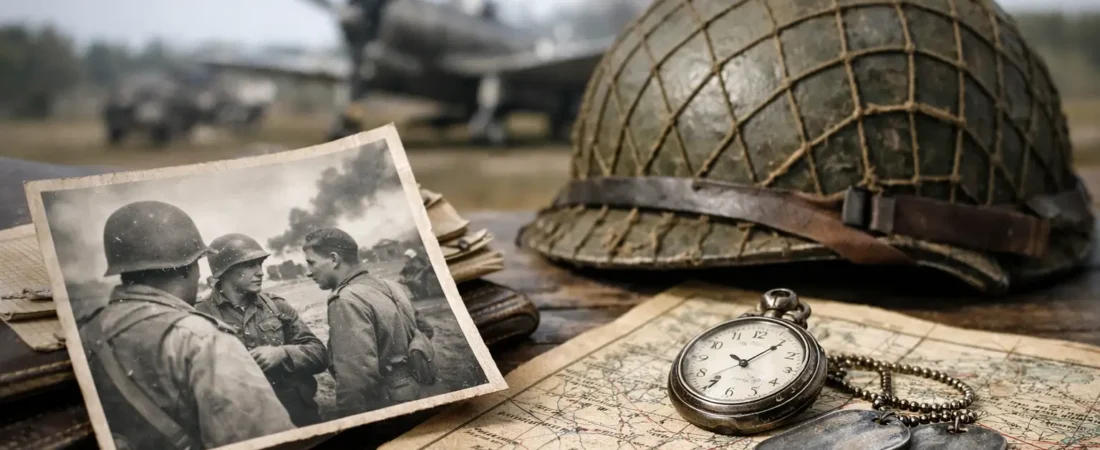
The most compelling World War II stories are often preserved in modest objects: a ration book with a name inside, a field postcard stamped by a censor, a fading group portrait, a service medal kept in a kitchen drawer. These artifacts ask readers to slow down. Who made this object? Whose labor does it represent? What happened before and after the image was taken?
They also require restraint. Not every gap in the record should be filled with speculation. The historian’s task is not to make the past more dramatic than it was. It is to listen closely enough that ordinary experience can be understood on its own terms. A woman sorting mail, an operator tapping out coded messages, a sailor watching the horizon, and a soldier writing home from Europe each occupied a different corner of the same global catastrophe.
The next time a World War II photograph or family letter crosses your path, pause before looking for the famous name. Look instead for the unidentified face at the edge of the frame. History is often waiting there, not as a footnote, but as the person who makes the larger story possible.